Home / Guides / Winter tree care guide
Winter tree care in Troutman, NC: what to do now and what to wait on
Late fall and winter are a good time to look hard at your trees. Some work makes sense right away, and some is better left until late winter. This guide explains the difference. When you are ready, we can connect you with a local professional for a free estimate.
Why winter is a useful season for tree work
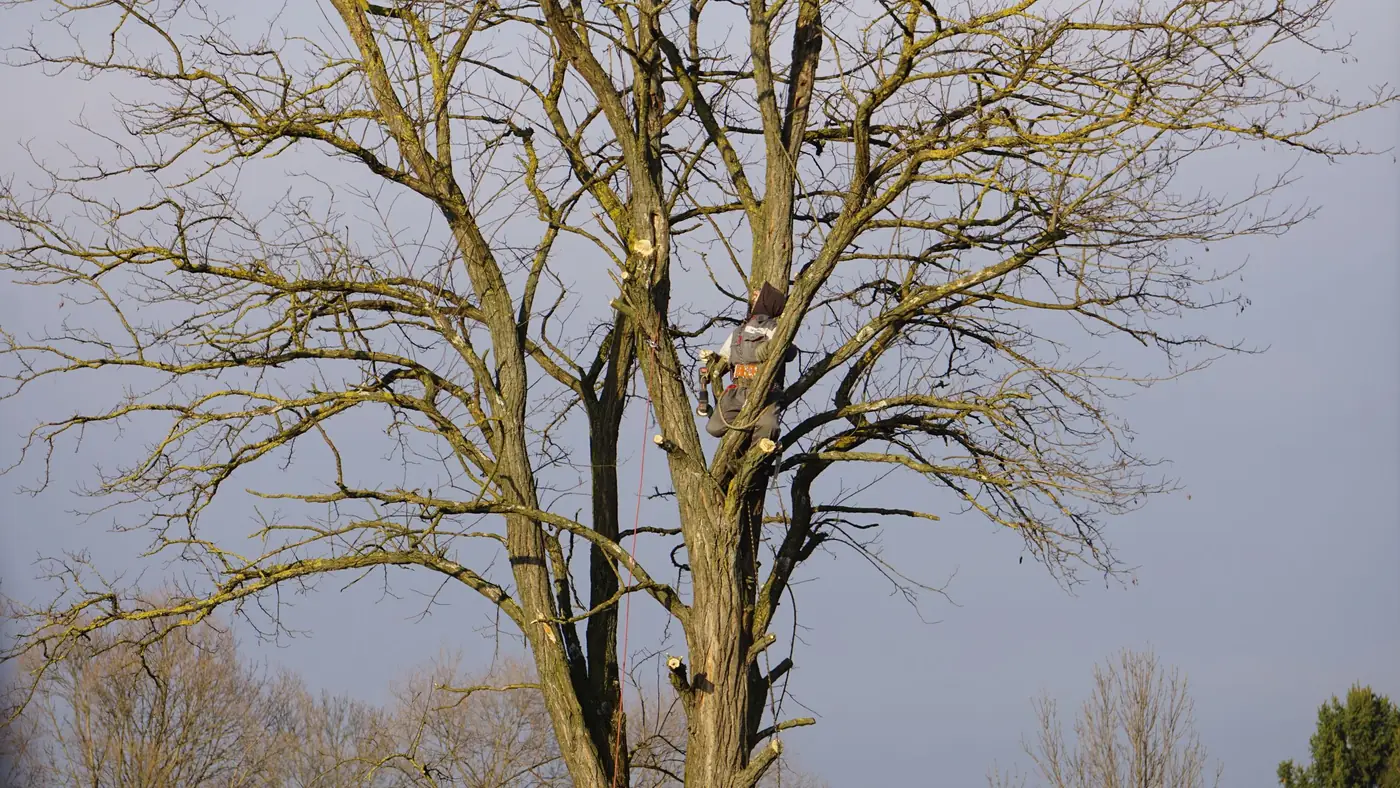
Most of the shade trees around Troutman, Mooresville, and Statesville are deciduous: oaks, maples, sweetgums, tulip poplars, hickories, and Bradford and other Callery pears. Once the leaves drop, you can see a tree’s structure clearly. Dead limbs, cracks, tight V-shaped unions, broken hangers left from summer storms, and limbs rubbing a roof are much easier to spot in December than in July.
That makes winter a practical time for a tree health or arborist assessment, for planning removals, and for lining up pruning at the right time. Schedules can also be less crowded than during spring and the summer storm season, but that varies from company to company. Ask about it when you request estimates.
Pruning: late winter usually beats late fall
It is tempting to prune right after the leaves fall. NC State Extension advises against it for most trees. Its General Pruning Techniques publication recommends holding off on pruning until late winter or early spring. That avoids leaving fresh wounds in autumn, when decay fungi are releasing spores. It also cautions against heavy dormant-season pruning of large, mature trees, and against removing many branches more than about 2 inches thick.
For most of the Piedmont, that means:
- Now through early winter: remove dead, broken, or hazardous limbs. NC State Extension notes that dead and broken branches can come out at any time. Leave structural and thinning cuts for later.
- Late winter, before buds break: do routine structural pruning on oaks, maples, sweetgums, crape myrtles, and similar trees. Avoid pruning right before or right after a hard freeze.
- After flowering: prune spring bloomers such as dogwoods, flowering cherries, and redbuds. Their flower buds are already set, so winter cuts remove the spring show.
Maples and birches often “bleed” sap when they are cut in late winter. Extension notes that this is seldom harmful. If it bothers you, ask the professional about timing. A good pruner should explain which cuts they plan to make and why. Topping is not an acceptable way to shorten a tree, and that includes topping a crape myrtle.
Getting ready for ice, not just wind
In the Piedmont, a winter storm is often freezing rain rather than snow. Ice adds weight to every limb at the same time, and the trees that fail are often the ones that already had a weak union, a long horizontal limb, or decay. Before the cold months:
- Walk the yard and note limbs over the roof, driveway, deck, play areas, and the service drop from the pole to your house.
- Look for cracks, cavities, mushrooms at the base, and bark falling off dead sections.
- Ask whether a weak union is a candidate for cabling or bracing, weight reduction, or removal.
- Note any trees that lean toward the house, especially if the soil has heaved or cracked on the side away from the lean.
If a limb is already hanging or a tree is cracked and moving, do not wait for late winter. Treat it as hazardous tree work. If a storm has already brought something down, see emergency and storm service.
Power lines are not a DIY job
Do not prune near energized lines yourself, and do not let anyone without the right qualifications do it. Depending on your address, your electric provider may be Duke Energy, EnergyUnited, or a town utility. Lines from the pole to the street are usually the utility’s responsibility. The service line to your house can be handled differently. Call your provider first. Tell the tree professional about any lines when you request an estimate.
Removal and stumps in the off-season
Without leaves, crews can see where limbs will fall and rig them more cleanly, and there is less debris to haul away. On the other hand, wet Iredell County clay can rut a lawn if heavy equipment crosses it after a rain. Ask how the crew will protect turf, septic areas, and irrigation. If you want the stump gone afterward, ask whether stump grinding is included or priced separately. For a rough idea of published price ranges, see the cost guide. Your own estimate will depend on the tree, access, and what sits under it.
A short winter checklist
- Photograph each large tree near the house from two sides while the leaves are off.
- Mark dead limbs, cracks, and anything over the roof or driveway.
- Check whether your HOA, the town, or a lakefront buffer has rules about removal (see the Lake Norman page for shoreline notes).
- Request a free estimate for hazard work now, and schedule routine pruning for late winter.
- Ask each professional to confirm insurance and to put the scope in writing.
Call (704) 826-5478 or use the quote form to tell us what you are seeing. We will connect you with an independent local tree professional. We do not prune or remove trees ourselves.
Related pages
Frequently asked questions
Is November a good time to prune trees in Troutman?
For most trees, it is better to remove only dead, broken, or hazardous limbs now and save routine pruning for late winter. NC State Extension recommends avoiding pruning wounds in autumn, when decay fungi are releasing spores.
When should I prune a dogwood or flowering cherry?
Prune them right after they bloom in spring. Their flower buds form the year before, so winter pruning removes the flowers.
Can a tree be removed in winter?
Yes. Removals are done year-round, and leaf-off conditions can make rigging easier. Ask how the crew will protect a wet lawn and anything underground.
Will cabling make a tree safe in an ice storm?
Not by itself. Cabling can reduce movement in a weak union, but it does not make a tree ice-proof. A professional should say honestly whether support, weight reduction, or removal makes the most sense.
Do you do the tree work?
No. This website is a free-estimate referral service. We connect you with independently owned local tree professionals, who quote and perform the work.
Ready for a free estimate?
Call or send a short description of the work. We will connect you with a vetted local tree professional who can walk the property and give you a written estimate.